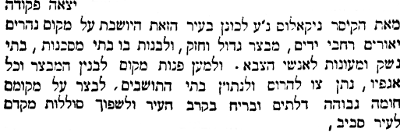
In a chapter summarizing the history of Brest from 1831 to the time of writing (~1883), Feinstein describes events a year after the big fire of 1835:
The English translation:
Tsar
Nicholas decided
to build in this city, located on two rivers, a strong fortress
with storage places for ammunition as well as barracks for
soldiers. He ordered the demolition of the houses of the
inhabitants to replace them with a high wall, a fortified gate, and outer dikes.
The ancient big synagogue of the old city was spared for the moment.
Translation:
Only the ancient synagogue stayed intact over there [on the site of the new fortress], until 5602 (1842) when it was hit by the cup of poison [a fatal blow]: it was completely demolished and nothing was left of this house of God.
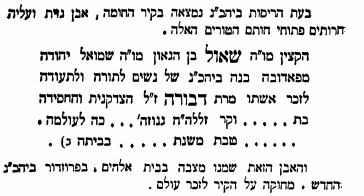
Eventually, the ancient synagogue was demolished. In the process, an important artifact was found: a stone tablet. Rabbi Feinstein tells of this:
Translation:
When
the synagogue was demolished they found an inscription on a stone
in the wall which reads as follows:
The katzin [officer,
leader] our teacher, Rabbi Shaul [Saul]. son of …Shmuel Yehuda of
Padua built the prayer house of women [women’s section=ezrat
Nashim]
in memory of his wife Dvora daughter of ..uker [probably: Druker
according to further resources.]
This
stone was placed in the foyer of the new synagogue...
Gdulat Shaul gives further details: the appearance of the stone and the specific hands through which it passed from the demolition site to the replacement synagogue in the new city.